My pharmacy closed. What happens to my prescriptions?
Your records were sold, not shredded — and if you don't act before the closing date, someone else decides where they go. A step-by-step guide, including the controlled-substance rules.
First, the part nobody tells you: your records don't disappear
When a pharmacy closes, it almost never shreds its files. It sells them. Your prescription history — every medication, dose and refill on record — is transferred, usually as a block, to another pharmacy that bought the files. Big chains typically move them to a nearby store in their own network; an independent that shuts its doors usually sells to whoever is closest.
That means two things. Your prescriptions are not lost. And you did not choose where they went.
Connecticut's Department of Consumer Protection puts it plainly: if you don't transfer your prescriptions yourself before the closing date, they will be transferred automatically to another pharmacy. How much notice you get before that happens is set by each state, not by federal law, so some patients get weeks and some get a sign taped to the door.
The practical takeaway: the moment you hear a closing date, you have a window in which you decide where your prescriptions go. After it, someone else has decided for you.
Why this is happening to so many people
This is not an unlucky-neighborhood problem. A 2024 study in Health Affairs found that nearly one in three US retail pharmacies closed between 2010 and 2021 — and closures hit Black and Latino neighborhoods hardest, at 37.5% and 35.6% versus 27.7% in White neighborhoods. Independent pharmacies closed at more than twice the rate of chains.
The chains have followed. CVS has closed more than 1,100 stores since 2022. Rite Aid, after bankruptcy, has closed every store it had. Walgreens is closing locations through 2026. By the count in Health Affairs Scholar, 15.8 million Americans — 4.7% of the population — now live in a pharmacy desert, defined by both low income and no pharmacy within reasonable reach.
So the sign on the door is a national pattern, and the next-nearest pharmacy is, for a lot of people, now a long way off.
Seven things to do before the doors lock
The Institute for Safe Medication Practices publishes guidance for exactly this situation. Here is the sequence that matters, in order.
1. Get your dispense history in writing
Go to the closing pharmacy and ask for a printed dispense history — every medication filled for you in the past year. This is your proof of what you take, and it is far easier to get while the store is open than after the files have moved.
2. Check what you have on hand
Count out your supply of anything you take daily. Transfers take days, sometimes longer when a new pharmacy has to order a medication. Blood pressure, thyroid, diabetes, seizure, heart and psychiatric medications are the ones you cannot afford a gap on. If you are within a week of running out, fill now, before the transfer.
3. Choose your new pharmacy — on your terms
This is the step people skip, and it is the one that sets the next five years. The automatic transfer sends your files to whichever pharmacy bought them. That store may be across town, may not take your insurance as favorably, and may not be the one you'd pick.
You are allowed to pick. Consider which pharmacies your plan prefers, whether you want an independent with a pharmacist who will know you, and — this is the one people underweight — how you will physically get your medication home every month. If the answer is a 30-minute drive, that is a monthly tax on your health, and it is the kind of friction that causes people to quietly stop filling. (We wrote about why prescriptions get abandoned; distance was one of the biggest reasons.)
4. Ask for the transfer — now
Call your chosen pharmacy and ask them to request the transfer from the closing store. Pharmacies do this pharmacist-to-pharmacist; you do not have to carry anything. Start it as soon as you have a closing date, because once files move automatically, they may have to be transferred a second time.
5. Know the rules for controlled substances
Controlled medications — ADHD stimulants, certain pain medications, benzodiazepines, some sleep aids — move differently. Since August 2023, a DEA rule allows an electronic prescription for a Schedule II–V controlled substance to be transferred between pharmacies once, for its initial fill, at your request, where state law permits. Schedule II prescriptions have no refills, so a transferred one covers only that single fill; for the next one, your prescriber sends a new prescription to your new pharmacy. If the closing pharmacy's version was on paper, call your prescriber and have a fresh one sent.
6. Tell your prescribers
Every doctor, clinic and specialist who sends you prescriptions has your old pharmacy saved in their system. Until you tell them, new prescriptions will keep going to a closed store. One call or portal message per office.
7. Verify the first fill at the new pharmacy
When you pick up (or receive) your first order, read every label against your dispense history. Transfers are done by people, and a wrong strength or a missing medication is easiest to fix on day one.
The step after the transfer: getting it home
Here is what we see at Pills2Me after a pharmacy closes in a neighborhood: patients transfer to a store that is fine on paper and far in practice. The transfer solved the records problem and created a transportation problem.
Pills2Me is not a pharmacy. We can't transfer your prescription, fill it, or dispense it. What we do is narrower: once your prescription is filled and waiting at your pharmacy — any pharmacy, CVS, Walgreens, Kroger, Costco, or the independent you chose on purpose — you tell the Pills2Me AI Assistant, by text or by voice, and a trained Pills2Me caregiver collects it and brings it to your door, the same day.
That changes step 3. You no longer have to choose the nearest pharmacy. You can choose the right one — the independent across town that knows your history, or the chain your plan prefers — and let the last two miles be our problem. We serve Houston, Las Vegas, and metros nationwide; the full how-to is here.
A short checklist to screenshot
- Printed dispense history from the closing pharmacy
- Enough supply on hand to cover a week-plus
- New pharmacy chosen deliberately — insurance, pharmacist, and how you'll get it home
- Transfer requested by your new pharmacy, pharmacist-to-pharmacist
- Controlled substances: electronic scripts transfer once; otherwise, new script from your prescriber
- Every prescriber told the new pharmacy name
- First fill checked label-by-label
Pharmacies are closing. Your access to medication doesn't have to close with them.
Pills2Me is not a pharmacy. Prescriptions are dispensed by licensed partner pharmacies. Pills2Me is HIPAA-compliant. This article is general information, not medical or legal advice — rules for prescription transfers vary by state. Talk to your pharmacist about your own medications.
Sources: Guadamuz J et al., Health Affairs (2024) · Wittenauer R et al., Health Affairs Scholar (2024) · Institute for Safe Medication Practices, What Do You Do When Your Retail Pharmacy Closes Its Doors · Connecticut Department of Consumer Protection, What should I do if my pharmacy is closing? · DEA Final Rule, Transfer of Electronic Prescriptions for Schedules II–V Controlled Substances (effective Aug 28, 2023) · Newsweek, Major Pharmacy Chains Close Hundreds of Stores Nationwide (Mar 2026)
Frequently asked questions
What happens to my prescriptions when my pharmacy closes?
They are not lost. A closing pharmacy almost always sells or transfers its patient files to another pharmacy, and if you do not transfer your prescriptions yourself before the closing date, they are moved automatically to that pharmacy. Ask the closing store where your records are going, and request a transfer to the pharmacy you actually want.
How do I transfer my prescriptions to a new pharmacy?
Call the pharmacy you want to use and ask them to request the transfer from the closing pharmacy. Transfers are done pharmacist-to-pharmacist; you do not need to carry anything. Start as soon as you know the closing date, and get a printed dispense history from the old pharmacy first so you can verify the transfer.
Can controlled substance prescriptions be transferred when a pharmacy closes?
Since August 2023, a DEA rule allows an electronic prescription for a Schedule II through V controlled substance to be transferred between pharmacies once, for its initial fill, at the patient's request and where state law permits. Schedule II prescriptions have no refills, so after that single fill your prescriber sends a new prescription to the new pharmacy. Paper prescriptions cannot be transferred this way; ask your prescriber for a new one.
How much notice does a pharmacy have to give before closing?
It depends on the state. There is no single federal notice requirement, so advance warning ranges from several weeks to very little. Treat the first notice you see as your deadline to choose a new pharmacy and request the transfer.
Can Pills2Me transfer or fill my prescription?
No. Pills2Me is not a pharmacy and does not transfer, fill, or dispense prescriptions. Once your prescription is already filled and waiting at the pharmacy you chose, a trained Pills2Me caregiver collects it and delivers it to your door the same day, so you can pick a pharmacy based on insurance and quality rather than distance.
Leslie Asanga, PharmD, MBA, MPH
Founder & CEO, Pills2Me
Leslie Asanga, PharmD, MBA, MPH, is the founder and CEO of Pills2Me.
Related posts
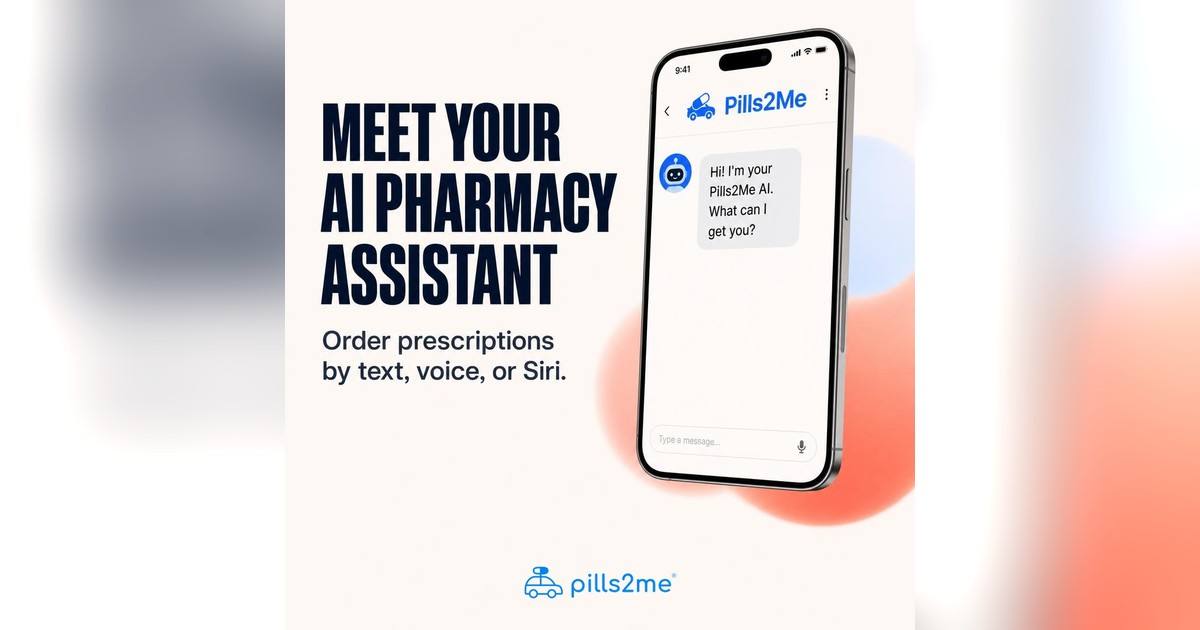
The Pills2Me AI Assistant is here: order prescription delivery by text or voice
The Pills2Me AI Assistant is officially live. Get same-day prescription delivery from any pharmacy — CVS, Walgreens or your local independent — by text, voice, Siri or Google, in 50+ languages. Your first delivery is free.
The prescription that never makes it home
Nearly a third of new prescriptions are never picked up. The reasons are rarely medical — they are cost, distance, transportation and time. A look at what the data shows, and which barriers delivery can actually remove.
Get your prescriptions delivered in minutes
Pills2Me picks up from any pharmacy — CVS, Walgreens, or your local independent — and delivers to your door.